
When Steve Jobs blessed the world with the first Macintosh Computer in 1984, everything changed. In the years that followed, he transformed from a computer geek into a dynamic and successful Silicon Valley powerhouse. In the three years since his death, four major motion pictures have been produced to study his complex genius.
Society’s fascination with Steve Jobs is not unwarranted. Under his guidance, Apple dominated the technology world and established itself as an iconic trendsetting brand. Apple did not know the meaning of the word failure. Every new product was met with an overwhelming amount of customer support and set the standard for the rest of the industry. Apple marketed a lifestyle, which everyone wanted to be apart of.
So some eyebrows were definitely raised when Apple decided to enter the highly competitive and segmented “streaming war” 12 years after Steve Jobs famously called the subscription model “the wrong path” for the music industry. Not only was Apple disregarding its iconic leader’s advice, but it was also entering this market almost 10 years after its inception—no longer setting the trends, but following them.
And now, almost five months after the debut of Apple’s highly so-called “revolutionary” music streaming service, Apple Music, some people are wondering if Apple should have listened to Steve and avoided this expanding market trend altogether.
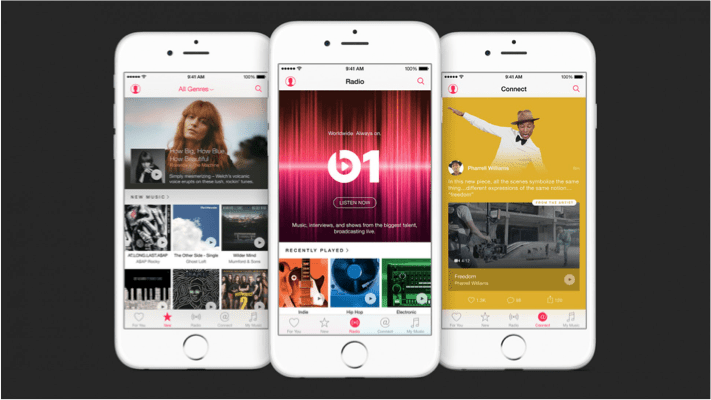
Apple’s missteps began in early June, when it began rolling out its first wave of promotional videos in anticipation of the platform’s June 30 launch. The rhetoric of the advertisements painted Apple Music as a platform that aimed to treat “music less like digital bits and more like the art it is” and to support “the artists who make the music, and not just the top tier artists, but the kids in their bedrooms too,” but its actions didn’t quite align with its marketing message.
On June 8, when Apple published its first online advertisement, two of the largest and most prominent indie labels in the world, XL Recordings and ATO Records, had not yet agreed to Apple Music’s terms and conditions and, therefore, had not yet released distribution rights to the tech juggernaut.

Regardless, Apple’s advertisement was saturated with clips, images and references to Alabama Shakes and FKA Twigs, two artists on XL Recordings’ and ATO Records’ label.
The parent company of XL Recordings, Beggars Group, released a statement on June 17 asserting that it would not validate Apple Music’s terms, making the music of all musicians affiliated with Beggars Group (including artists like the Arctic Monkeys, Radiohead and FKA Twigs) unavailable to stream on Apple Music.
Apple’s apparent assumption that the indie labels would accept the terms Apple offered proved to be a major miscalculation, since it left Apple with misleading ads that suggested that tracks from those artists would be available for users, according to industry critics.
Beggars Group echoed the complaints of indie labels around the world when it took issue with Apple’s refusal to compensate indie artists, labels and rights holders during the service’s initial three-month free trial. It also criticized Apple’s decision to negotiate very different deals with the larger labels such as Universal, Sony and Warner Music.

“We are naturally very concerned, especially for artists releasing new albums in the next three months, that all streaming on the new service will be unremunerated until the end of September,” the Beggars Group said in a statement. “Whilst we understand the logic of their proposal and their aim to introduce a subscription-only service, we struggle to see why rights owners and artists should bear this aspect of Apple’s customer acquisition costs.”
In the three-week span from when Apple proposed its terms to when the platform actually launched, indie labels across the globe cohesively took a stand against Apple and its presumptuous supposition that no label would want to miss out on this music “revolution” or say no to the most famous tech giant in the industry.
“If you are running a small label on tight margins you literally can’t afford to do this free trial business,” said Andy Heath, chairman of the British lobby group, UK Music, in an interview with The Telegraph. “Their plan is clearly to move people over from downloads, which is fine, but it will mean us losing those revenues for three months. Apple hasn’t thought this through at all and it’s not like them. They can’t spring a contract like this on us three weeks from release … Smaller labels would be completely screwed.”
And, with a little help from Taylor Swift, the mounting criticism of Apple Music’s terms and overall attitude towards the smaller labels and artists effectively pressured Apple into agreeing to pay all artists—even during the free trial.
Apple’s second misstep was its apparent lack of an overall marketing strategy.
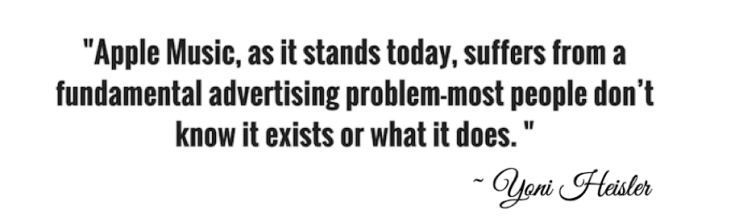
“At the core, the problem with Apple Music is that Apple has done a horribly poor job of letting people know that a) it exists and b) what it does,” wrote Yoni Heisler in one of his many columns about Apple in the technology-focused publication, BGR. “This is a completely new service from Apple, one that can potentially yield them a lot of money, and yet, they’ve done a surprisingly poor job of advertising it.”
And the numbers reaffirm Heisler’s argument.
Apple lost about 40 percent of its subscribers when its three-month free trial recently ended. It now maintains 6.5 million users. In contrast, its primary competitor, Spotify retains 20 million paying subscribers with an additional 75 million users using the “freemium” ad-supported option (an option that Apple Music does not provide).
“If it were some other company, to go from a standing start to 6.5 million users we’d be like, ‘wow that’s incredible!’” said Ben Bentzin, previous director of marketing for Dell Inc. and graduate marketing lecturer at the McCombs School of Business. “But because it’s Apple, and because it’s a fairly mature market, we’re comparing 6.5 million against our expectations for Apple and against the numbers that YouTube, Spotify and Pandora have, and saying, ‘you know that doesn’t look so good.’”
All of these missteps and the poor results raise the question of whether Apple has forgotten its humble beginnings.
“This whole situation is shocking,” said Monica Fishbein, a sophomore psychology student at the University of Texas at Austin. “I’ve always thought of Apple as being this progressive and innovative company and it really seems like they just think they don’t even need to try anymore and that everyone will always buy from them because its Apple. And that really saddens me.”
Despite an underwhelming start felt by Apple Music critics, Apple executives are not concerned about the current state of the new platform.
“Everyone gets fixated on the short term,” said Apple’s senior vice president of Internet Software and Services, Eddy Cue, in an interview with the Evening Standard. “But we’re in this for the long haul.”
 kaitlinreid.com